Fragrance-free vs. unscented: what the labels mean

Forty-five percent. That's the share of best-selling moisturizers labeled "fragrance free" that turned out to contain at least one fragrance cross-reactor or botanical ingredient when researchers actually read the ingredient lists. Not a rogue brand. Not a loophole someone exploited. Standard practice, on shelves, in products people with eczema were buying specifically because of that label.
The difference between fragrance-free vs. unscented is the first thing to understand if your skin reacts to things, and it's not a semantic distinction. It changes what's in the bottle. It's also, unhelpfully, a distinction no US regulator enforces.
Fragrance-free vs. unscented: the difference
Fragrance-free means fragrance materials and masking scents weren't used in the product. Unscented generally means the product may contain chemicals that neutralize or mask the odors of other ingredients. That's the EPA's own framing, and it's the cleanest version of the distinction available.
Read those two definitions again, because the second one is counterintuitive. "Unscented" doesn't mean nothing was added. It often means something was added, specifically to cancel out a smell. Raw cosmetic ingredients frequently smell unpleasant on their own, and a masking agent is a fragrance chemical whose job is to make the product smell like nothing at all. The absence of scent is the achievement. The chemicals doing the achieving are still on your face.
| Fragrance-free | Unscented | |
|---|---|---|
| Added scent ingredients | No | No scent intended, but masking agents likely |
| Masking agents | Excluded, in strict use | Commonly present |
| Smells like nothing | Not necessarily, raw ingredients may smell | Yes, by design |
| FDA-defined | No | No |
| Better for reactive skin | Yes | Not reliably |
A fragrance-free product may actually smell like something, since raw ingredients have odors and nothing was added to hide them. That faint neutral smell is a feature: it means nobody added a chemical to lie to your nose.
Why neither term is regulated
The FDA does not define or regulate "fragrance-free" or "unscented" in cosmetics. What the FDA does define is fragrance itself: any natural or synthetic substance used solely to impart an odor to a cosmetic product. That definition creates the loophole rather than closing it, because an ingredient added to mask odor isn't, technically, added solely to impart odor.
There's a second, larger gap. Manufacturers can group fragrance components under a single umbrella term on the label, "fragrance" or "parfum," without listing what's inside it. That collection can contain dozens of individual compounds. The EU has identified 26 fragrance ingredients as allergens requiring disclosure; Health Canada amended its rules in 2024 to require disclosure of fragrance allergens, phasing in from 2026. The US passed MoCRA in December 2022, the first significant update to cosmetic regulation since 1938, which gives the FDA more authority including mandatory recalls. But the specific rules naming which fragrance allergens must be disclosed haven't been issued, so in practice the umbrella term still stands.
"45% of best-selling moisturizers labeled 'fragrance free' contained at least one fragrance cross-reactor or botanical ingredient. Only 12% of all the moisturizers studied were free of common allergens entirely."Source: Xu et al., JAMA Dermatology, 2017
That study is worth sitting with. It's from 2017, and we're including it because nothing more recent covers the same ground and the labeling gap it identified hasn't closed. The researchers checked products against the North American Contact Dermatitis Group's list of common allergens. The three most common allergens across all 174 products were fragrance mix, paraben mix, and tocopherol. Price made no difference: products free of allergens weren't more expensive than those containing them.
No fragrance, no detergent, no residue
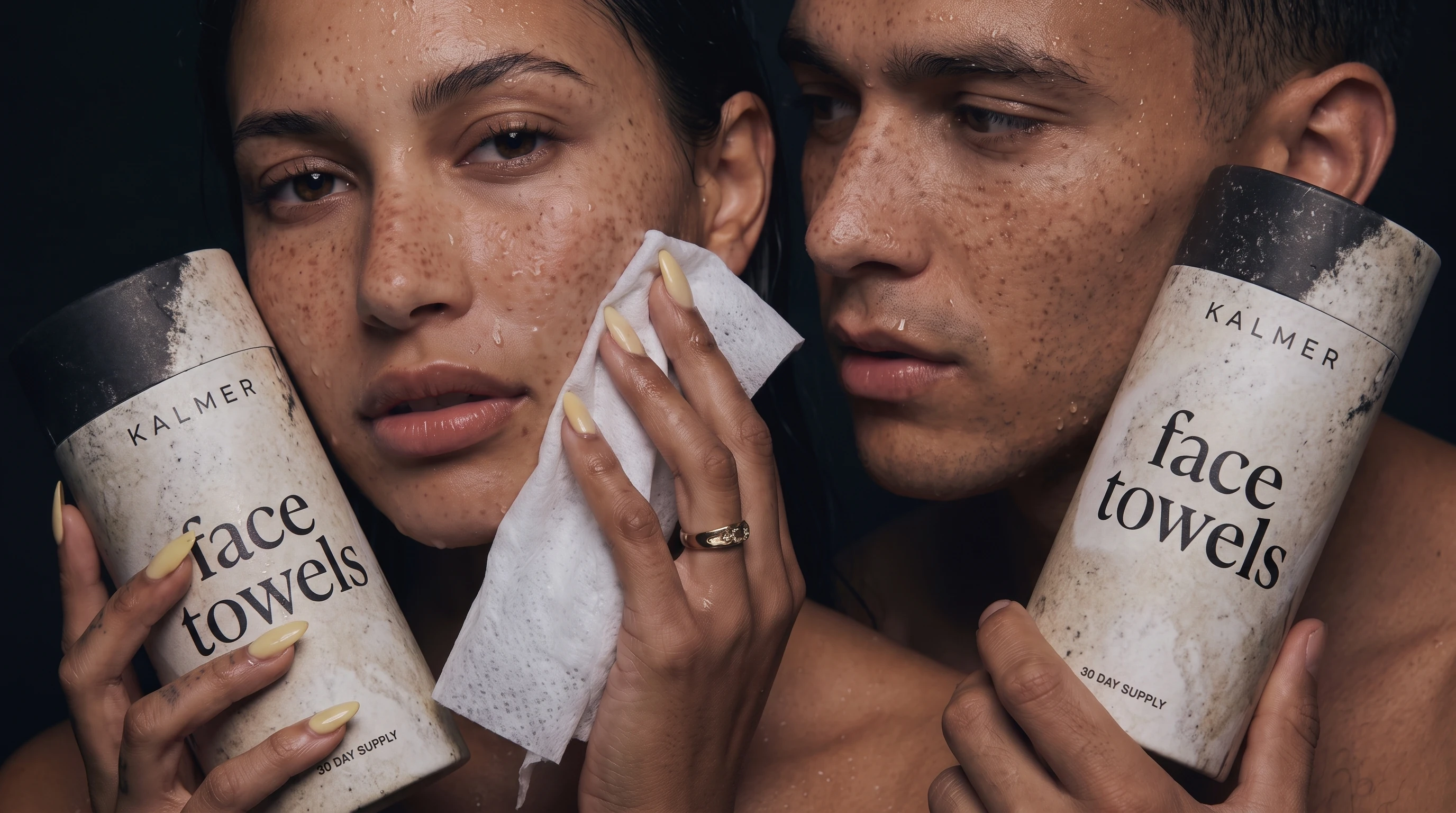
A reusable towel carries whatever you washed it in. KALMER towels are fragrance-free and single-use, so there's no detergent film and no softener residue between the fabric and your face.
Shop KALMERWhy this matters for sensitive skin
Fragrance is one of the most common contact allergens in personal care, and reactions don't always announce themselves. Up to 10 percent of patients presenting with contact dermatitis test positive for fragrance allergens, and many of those cases trace back to products marketed as gentle or for sensitive skin. The product you chose because your skin is reactive is a plausible reason your skin is reacting.
Fragrance allergy also cross-reacts. If you're allergic to one fragrance compound, your risk of reacting to others rises, because of the chemical similarity between them. That's what "cross-reactor" means in the study above, and it's why botanicals count. An essential oil is fragrance for these purposes, and the idea that a natural scent is inherently safer doesn't survive contact with a patch test.
This is also why a damaged skin barrier and fragrance sensitivity travel together so often. A barrier that's sealing properly keeps most of this out. A compromised one doesn't, so the same product that was fine last year provokes a reaction this year, and the ingredient didn't change. You did. Reactions also arrive on a delay: a product can sting immediately, or produce a low-grade flare days later that you never connect to the bottle, which is why people with sensitive skin end up with a shelf of half-used products and no idea which one is the problem.
The fragrance you're not thinking about is the one in your laundry. Detergent and fabric softener are common sources of fragrance allergens, and they don't rinse out completely. Anything you wash and then press against your face, a towel, a pillowcase, a washcloth, carries that residue to your skin. If you've eliminated fragrance from every product you own and your face is still reacting, the thing you dried it with is a genuinely plausible suspect, one more reason your face towel deserves attention. Fabric softener in particular leaves a wax-like coating on fabric by design.
How to actually read the label
The front label is marketing. The ingredient list is the product. That's the whole method, but a few specifics make it work.
Look for "fragrance-free" rather than "unscented," since it's the stricter term even though neither is enforced. This matters most on anything that stays on your skin, and on the products you use most frequently, which for most people means cleanser and moisturizer. If you're cleansing twice a day, per standard face-washing guidance, that's fourteen exposures a week to whatever's in the bottle. Then flip the package over and scan the ingredient list for the words fragrance, parfum, aroma, or any essential oil or botanical extract named individually.
Prefer brands that voluntarily disclose their individual fragrance components rather than hiding behind the umbrella term. Third-party standards help here: the National Eczema Association's Seal of Acceptance requires no added fragrance materials or masking agents at all, which is stricter than the unenforced front label.
One habit worth building: check the ingredient list before you buy, not after your skin reacts. It takes fifteen seconds on a product page and it saves the entire cycle of buying, trying, flaring, and trying to reverse-engineer which of the four new things did it. The ingredient list is public. Almost nobody reads it, which is exactly why the front label can say whatever it wants.
And patch test. Apply a small amount to a discreet area for several days before committing it to your face. This is unglamorous and it's the only method that accounts for your specific skin rather than the population average. It's worth being clear-eyed about what a front label is for: it exists to make a product easier to choose, quickly, by a person standing in an aisle who doesn't have a background in cosmetic chemistry. That's a legitimate job. The problem is that when the term doing the work isn't defined by anyone, the label stops being a summary of the formulation and becomes a summary of the marketing. We use fragrance-free on our own products, and the only thing that makes it meaningful is the ingredient list sitting behind it. Ask that of every brand, including this one.
When to see a dermatologist
See a board-certified dermatologist if you have persistent redness, itching, stinging, or a rash you can't trace to a specific product, if your skin reacts to most things you try, or if you suspect a fragrance allergy and want to know which compounds are the problem. Patch testing is a real diagnostic procedure, not a guess, and knowing what you react to turns shopping from a lottery into a rule.
Fragrance-free means no fragrance or masking scents were used. Unscented means the smell was engineered away, often with fragrance chemicals. Neither term is defined or enforced by the FDA, and 45 percent of moisturizers using the stricter of the two still contained fragrance cross-reactors when someone checked. Look for fragrance-free, verify it on the ingredient list, treat essential oils as fragrance, and remember that your detergent counts too. The label is a claim. The ingredient list is evidence. Only one of them is worth trusting.
Frequently asked questions
What is the difference between fragrance-free and unscented?
+
Fragrance-free means fragrance materials and masking scents weren't used in the product. Unscented means the product has no noticeable odor, but it may contain chemicals that neutralize or mask the smell of other ingredients. If you react to fragrance, fragrance-free is the term to look for.
Is unscented the same as fragrance-free?
+
No. An unscented product can still contain fragrance chemicals, added specifically to cancel out the smell of other ingredients rather than to make the product smell nice. Those masking agents can still be allergens.
Is fragrance-free regulated by the FDA?
+
No. The FDA does not define or regulate the terms fragrance-free or unscented in cosmetics. The FDA does define fragrance as a substance used solely to give a cosmetic an odor, but manufacturers have wide latitude in how they apply the front-label terms.
Are essential oils considered fragrance?
+
Yes, for the purposes of skin sensitivity. Botanical and essential-oil ingredients can be fragrance allergens or cross-reactors even though they're natural, and stricter fragrance-free standards exclude them. Natural is not the same as non-reactive.
Sources
- US Environmental Protection Agency, Safer Choice Criteria for Fragrance-Free Products
- US Food and Drug Administration, Fragrances in Cosmetics
- Xu S, Kwa M, Lohman ME, Evers-Meltzer R, Silverberg JI (2017). Consumer Preferences, Product Characteristics, and Potentially Allergenic Ingredients in Best-selling Moisturizers. JAMA Dermatology 153(11):1099-1105.
- US Food and Drug Administration, Modernization of Cosmetics Regulation Act of 2022 (MoCRA)
- Canada Gazette, Regulations Amending Certain Regulations Concerning the Disclosure of Cosmetic Ingredients (2024)