Dry skin vs dehydrated skin: how to tell

You moisturize religiously, twice a day, with a product that cost more than you want to admit, and your skin still feels tight, dull, and somehow both flaky and oily at the same time. The problem might be that you are solving the wrong deficiency. Dry skin vs dehydrated skin is one of the most useful distinctions in all of skincare, because the two feel almost identical and need opposite fixes. One lacks oil, the other lacks water, and treating a water problem with more oil, or an oil problem with more water, is why so many people feel stuck. Here is how to tell which you have.
The distinction sounds academic until you realize it explains why your routine is not working. So let us make it concrete, including a quick test you can do right now.
Dry skin vs dehydrated skin: the core difference
Dry skin is a skin type that lacks oil; dehydrated skin is a condition that lacks water. That is the whole distinction, and everything else follows from it. Dry skin is part of your natural makeup, largely genetic, like having oily or combination skin, and it means your skin does not produce enough sebum, the oil that keeps it soft and protected. It is your skin's usual default state.
Dehydrated skin is different in kind. It is a temporary condition, not a type, and it means your skin is short on water in its upper layers. Crucially, it can happen to anyone, including people with oily or combination skin, which is why someone with a shiny T-zone can still be dehydrated and confused about it. Dry skin is what you are; dehydrated skin is what happened. One is a trait, the other is a state, and that difference is the key to fixing either.
| Dry skin | Dehydrated skin | |
|---|---|---|
| What it is | A skin type | A temporary condition |
| Lacks | Oil (sebum) | Water |
| Affects | People with dry type | Any type, even oily |
| Feels | Rough, flaky, tight | Dull, tight, can be oily too |
| Cause | Genetics, low oil production | Weather, travel, harsh products, low intake |
| Needs | Oils and lipids | Water-binding humectants |
How to tell which you have
Dry skin feels rough and flaky; dehydrated skin looks dull and can feel oily and tight at once. Those different signatures are how you tell them apart day to day. Dry skin tends to be persistently rough, flaky, sometimes scaly, and tight, and it is your normal condition rather than something that came on suddenly. It is also worth knowing that dehydration can be caused by things you would never suspect: screen time and indoor heating, air conditioning, a long flight, and even over-cleansing, since stripping the skin removes the very layer that holds water in, the same way over-exfoliation does. It may itch, and in cold or low-humidity weather it gets worse.
Dehydrated skin has a more confusing presentation. It often looks dull and lacks glow, may show fine "dehydration lines" that are not true wrinkles, and can feel tight while your skin still produces oil, so you get the strange sensation of being oily and parched simultaneously. It also tends to be temporary and traceable to a trigger: a flight, a cold snap, a new harsh product, a stretch of poor sleep or low water intake. If your skin's discomfort arrived recently and does not match your usual state, lean dehydrated. If it is your everyday baseline, lean dry.
"Dehydrated skin can affect any skin type, including oily, because it is a temporary lack of water rather than a genetic lack of oil like dry skin."Source: CeraVe and dermatology group guidance
The pinch test
A quick at-home check points you in the right direction: the pinch test. Gently pinch a small amount of skin on your cheek, the back of your hand, or your abdomen, hold for a couple of seconds, and let go. If it snaps back quickly, your skin is probably well hydrated. If it takes a moment to settle back, or looks briefly crepey, that sluggish bounce suggests dehydration, because skin with enough water is more elastic and recovers faster.
The test is not definitive, and it is easier to read on some areas than others, but it is a useful nudge in the right direction, especially combined with the feel-and-look signs above. If your skin fails the pinch test and looks dull despite a decent moisturizer, water, not oil, is likely what it is missing. If it passes but still feels rough and flaky, oil is the more likely gap.
Do not strip what little you have
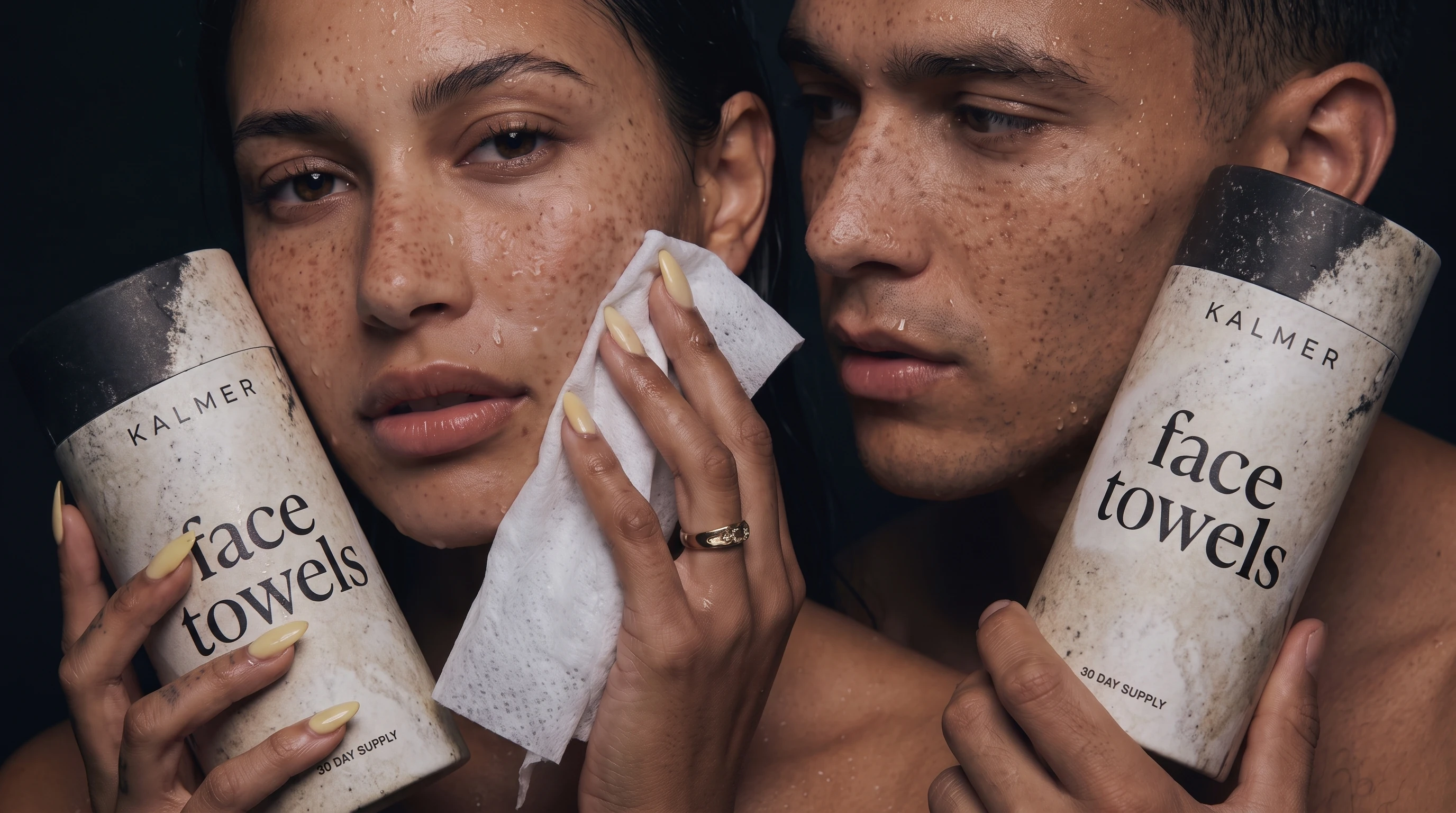
Both dry and dehydrated skin are made worse by harsh washing and rough drying. KALMER is a soft, single-use face towel: gentle to pat with and clean every time, so the drying step is not stripping skin that already needs more, not less.
Shop KALMERHow to treat each one
Dry skin needs oils and lipids; dehydrated skin needs water and humectants; and if you have both, you layer water first, then seal it. This is where the distinction finally pays off, because the treatments genuinely differ.
For dry skin, reach for richer, lipid-containing moisturizers with ingredients like ceramides, which replace the oils your skin is not making and support the barrier. Ointments and creams tend to beat lightweight gels here. For dehydrated skin, focus on water: use humectants such as hyaluronic acid and glycerin that pull and bind water into the skin, apply them to slightly damp skin, and then seal with a moisturizer so the water does not evaporate straight back out. A soft single-use towel like KALMER helps that damp-skin window in a small way, since patting rather than rubbing leaves the light film of water that makes humectants work, instead of dragging it all off. Just as important, remove the causes of the dehydration, harsh cleansers, hot water, over-exfoliation, and low water intake, since dehydrated skin will keep coming back if the drain is still open.
If you have both, which is common, do both in order: a water-binding humectant first, a richer lipid moisturizer on top. And whichever you are dealing with, be gentle, because both conditions leave the skin barrier more vulnerable, and harsh routines make each worse. A damaged skin barrier sits underneath a lot of stubborn dryness and dehydration, and repairing it helps both. The gentle approach in a sensitive-skin routine applies here too.
Over-washing and hot water strip both oil and water at once, which is how people accidentally give themselves both problems. A hot shower feels wonderful and removes the very lipids that hold water in, so you walk out with skin that is both drier and more dehydrated than when you went in. Lukewarm water, a gentle cleanser, and moisturizing on damp skin protect both. And the drying step matters more than people think, since dragging a rough towel across already-compromised skin adds insult to injury at the worst moment.
The mistake that makes both worse
The single most common error with dry and dehydrated skin is over-treating in the wrong direction, and it usually looks like adding more product. Someone with dehydrated skin slathers on a heavy oil-based cream, seals in nothing because there was no water to seal, and stays dull and tight. Someone with dry skin loads up on watery hydrating serums, which evaporate and leave the skin even drier than before. Both are working hard and getting nowhere because they matched the fix to the symptom rather than the cause. Once you know whether you are missing oil or water, the correction is usually simpler and cheaper than what you were already doing: often one right product replacing three wrong ones. Diagnosis first, product second, is the order that actually works here.
When to see a dermatologist
Most dryness and dehydration respond to routine changes, but some do not. See a board-certified dermatologist if your skin stays dry, tight, cracked, or irritated despite a gentle, well-matched routine, if you have painful cracking or bleeding, or if dryness is sudden and severe, since persistent dry skin can occasionally signal an underlying condition like eczema or, rarely, a systemic issue. A dermatologist can confirm your skin type, identify what is driving the problem, and prescribe treatment that over-the-counter products cannot.
Key takeaways
Dry skin vs dehydrated skin comes down to oil versus water: dry skin is a genetic skin type that lacks oil and feels rough and flaky, while dehydrated skin is a temporary condition that lacks water, can affect any skin type including oily, and looks dull with fine surface lines. Tell them apart by whether the problem is your baseline or recent, and use the pinch test as a quick check. Treat dry skin with lipids and richer moisturizers, dehydrated skin with humectants and by removing the causes, and if you have both, layer water first then seal it. Above all, be gentle, since harsh washing and rough drying make both worse.
The reassuring part is that both conditions are highly responsive once you aim correctly. Dehydration in particular often clears within a couple of weeks of adding water-binding ingredients and removing the causes, and even genetically dry skin can be brought to comfortable and healthy-looking with the right lipids and consistency. Neither is a life sentence, and neither requires an elaborate routine. What they require is the correct diagnosis, a couple of well-chosen products, and the restraint to stop stripping your skin in the shower every morning.
For that gentle drying step, KALMER is a soft, single-use towel: clean and gentle every time, so you are not stripping skin that already needs more, not less.
Frequently asked questions
What is the difference between dry and dehydrated skin?
+
Dry skin is a skin type, usually genetic, where the skin does not produce enough oil. Dehydrated skin is a temporary skin condition where the skin lacks water, and it can happen to anyone, including people with oily skin. In short, dry skin needs oil and dehydrated skin needs water, which is why they need different care.
How do I know if my skin is dry or dehydrated?
+
Dry skin tends to feel rough, flaky, and tight all the time and is your usual state. Dehydrated skin looks dull, may show fine surface lines, can feel oily and tight at the same time, and often comes on temporarily from weather, travel, or harsh products. The pinch test is a quick check: if pinched skin is slow to bounce back, it is likely dehydrated.
Can you have both dry and dehydrated skin?
+
Yes, and it is common. You can have a dry skin type that also lacks water at a given time, so your skin needs both oil and hydration. In that case, apply water-binding humectants first, then seal them in with a richer, lipid-containing moisturizer, and address the causes of the dehydration.
How do you fix dehydrated skin?
+
Focus on adding and sealing in water: use humectants like hyaluronic acid and glycerin, moisturize while skin is still damp, avoid harsh cleansers and hot water, and address external causes like low water intake, travel, heating, and over-exfoliation. Dehydrated skin usually improves within a few weeks once the causes are removed.
Sources
- Healthline, Dry vs. dehydrated skin: how to tell the difference
- CeraVe, Is my skin dry or dehydrated?
- Schweiger Dermatology Group, Dry vs dehydrated skin: how to tell the difference
- Del Rosso J, Zeichner J, Alexis A, et al. (2016). Understanding the epidermal barrier in healthy and compromised skin. Journal of Clinical and Aesthetic Dermatology, 9(4 Suppl 1):S2-S8.